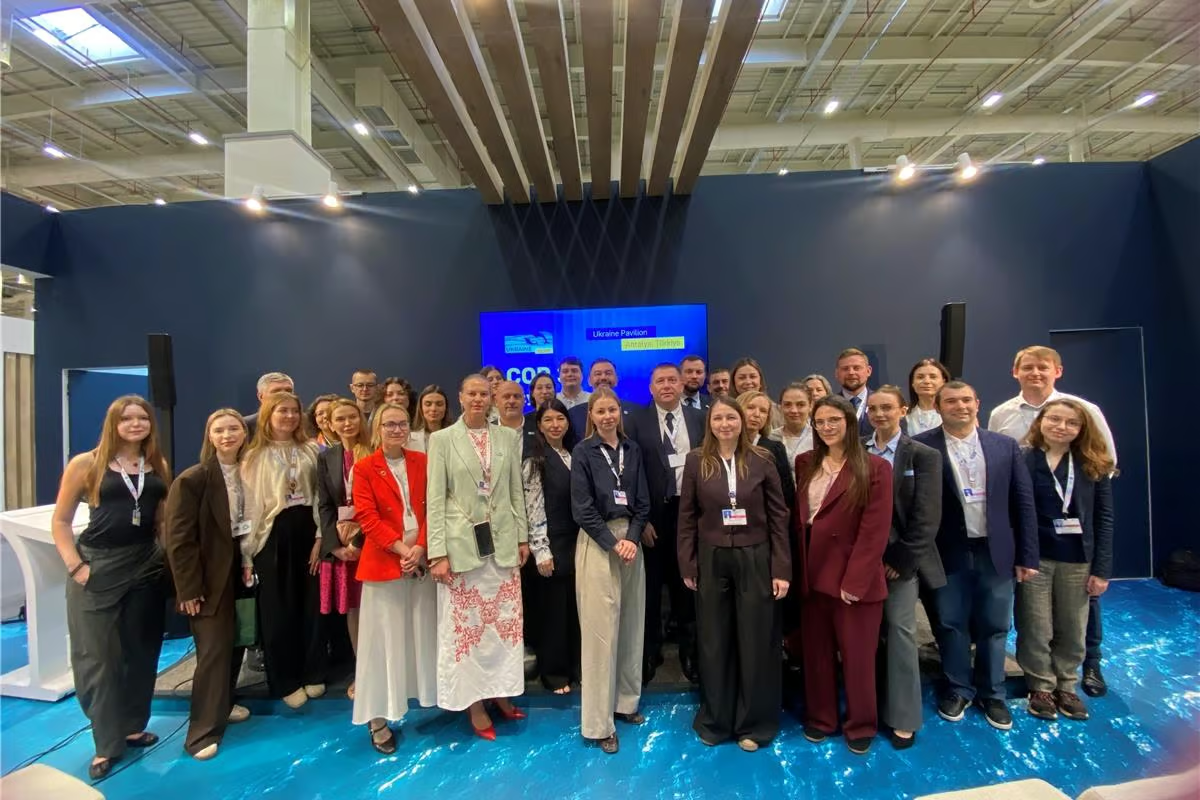
More than 70 events, over 5,000 visitors, and more than 40 bilateral meetings—these are the results of the Ukrainian pavilion’s participation in the UN Climate Change Conference (COP31) in Antalya. Over the course of two weeks, Ukraine presented solutions for green recovery, mobilizing climate finance, industrial modernization, water policy development, and environmental protection amid the war.
The second week of the conference was dedicated to the practical implementation of climate reforms, the development of international partnerships, the conservation of natural ecosystems, adaptation to climate change, and ensuring a reliable water supply.
One of the main events was a ministerial dialogue involving representatives of the European Commission, European governments, and international organizations. Ukraine presented the results of its 2026 climate reforms and its priorities for 2027. During the event, Kurt Vandenberge, Director-General of the European Commission’s DG CLIMA, noted Ukraine’s consistency in implementing climate policy despite the full-scale war and positively acknowledged Ukraine’s results based on the findings of the European Commission’s latest enlargement assessment.
Industrial decarbonization and the circular economy. Together with GIZ, participants discussed the implementation of integrated environmental permits and best available technologies and management practices (BATs) in accordance with EU requirements. Special attention was focused on waste reduction and the reuse of materials during reconstruction.
Ecosystem Conservation and Climate Finance. Participants explored opportunities to finance the restoration of Polissya peatlands through mechanisms under Article 6 of the Paris Agreement. During the discussion on the Ukrainian Carpathians, the focus was on protecting natural forests and biodiversity. The German side confirmed its intention to establish a nature conservation fund for Ukraine in the amount of 10 million euros.
Environmental Consequences of the War. Work continued on mechanisms for international compensation for environmental damage through the Register of Damages for Ukraine. According to estimates presented, environmental damage resulting from Russian aggression amounts to $119 billion, and additional greenhouse gas emissions exceeded 311 million metric tons.
Climate innovations. Greencubator presented Ukrainian innovations in the field of clean energy and eco-friendly materials, as well as the CleanMatch platform for attracting international partners and investors.
Climate Change Adaptation. Representatives from six countries in the Black Sea region, as part of the PAABS project, discussed joint approaches to combating droughts, floods, and coastal erosion. They also presented the results of the Adapterra UA competition, including the restoration of peatlands in Zalivky and greening initiatives using satellite data in Rivne.
Water Supply Resilience and Digital Solutions. Using Mykolaiv as a case study, participants examined the modernization of water supply infrastructure and the use of renewable energy to ensure its uninterrupted operation. A separate discussion focused on the application of artificial intelligence for the restoration of environmental data, climate monitoring and the development of clean energy.
International cooperation. During the second week of COP31, bilateral meetings were held with representatives from Germany, Estonia, UNIDO, and the UN on environmental monitoring, air quality, and the green modernization of industry in the context of preparations for the Ukraine Recovery Conference (URC 2027) in Tallinn. Separately, discussions were held with Japanese partners on priority sectors covered by the JCM mechanism, with representatives of the Climate Club on decarbonization issues, and with representatives of the European Parliament on the application of CBAM.
Following COP31, Ukraine will continue working with international partners to implement climate reforms, attract investment, and restore natural ecosystems.