
Alongside events at the Ukrainian Pavilion, Ukraine’s delegation – represented at high-level talks by Oleksandr Krasnolutskyi, Deputy Minister of Economy and Environment of Ukraine – held a series of bilateral and multilateral meetings on the sidelines of COP31 in Antalya to advance climate cooperation, institutional capacity building, and practical conditions for Ukraine’s post-war green recovery.
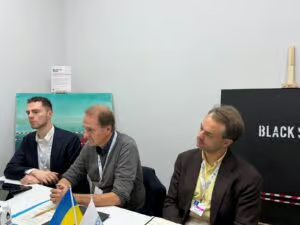 During a bilateral meeting with Dirk Messner, President of the German Environment Agency (UBA), Oleksandr Krasnolutskyi expressed Ukraine’s strong interest in drawing on Germany’s regulatory and technical expertise. Germany confirmed its readiness to support Ukraine across three core areas: coordinating the work of the environmental law working group, providing advisory support on forest and biodiversity conservation, and building long-term cooperation on the Emissions Trading System (ETS). Having joined the European network of environmental agencies, Ukraine will also receive German support to develop a national environmental monitoring agency aligned with EU standards ahead of future EU accession. Both sides emphasized the need to move from targeted initiatives toward establishing a dedicated institutional framework for long-term cooperation, with Krasnolutskyi affirming Ukraine’s political will and requesting Germany’s assistance in drafting a joint roadmap.
 In discussions with the Climate Club, Ukraine highlighted its goal of shifting from fragmented cooperation toward broader, systemic industrial partnerships in energy, metallurgy, cement, and chemicals to deploy low-carbon technologies. Key attention was given to Ukraine’s commitment to adopt national ETS legislation by April 1, 2027, in line with European Commission requirements, as well as the implementation of the EU Carbon Border Adjustment Mechanism (CBAM). Both in talks with the Climate Club and during a separate meeting with
 Mohammed Chahim, Member of the European Parliament from the Netherlands and EP rapporteur on CBAM, the Ukrainian delegation emphasized that while Ukraine remains committed to climate alignment, it is seeking a deferral of CBAM application until the end of the war so that Ukrainian enterprises, already facing severe wartime losses, can maintain competitiveness and ensure a smoother transition.
 Ukraine also contributed to high-level global climate dialogues, including the 2026 Annual High-Level Ministerial Roundtable on Pre-2030 Ambition on November 17, co-chaired by Germany’s Minister for the Environment, Climate Action, Nature Conservation and Nuclear Safety Carsten Schneider and India’s Minister for Environment, Forest and Climate Change Bhupender Yadav, which focused on accelerating practical mitigation solutions and strengthening the Sharm el-Sheikh Mitigation Ambition and Implementation Work Programme. Additionally, at the meeting of Joint Crediting Mechanism (JCM) partner countries hosted by Japan, Oleksandr Krasnolutskyi underscored that since joining the JCM in early 2024, Ukraine has established its side of the Joint Committee, adopted national rules under Article 6 of the Paris Agreement, and is launching a national carbon registry. Moving from framework decisions to concrete projects with Japanese partners across energy, industry, transport, agriculture, waste, and forestry will not only reduce emissions, he noted, but also strengthen Ukraine’s energy resilience amid ongoing attacks on its power grid.