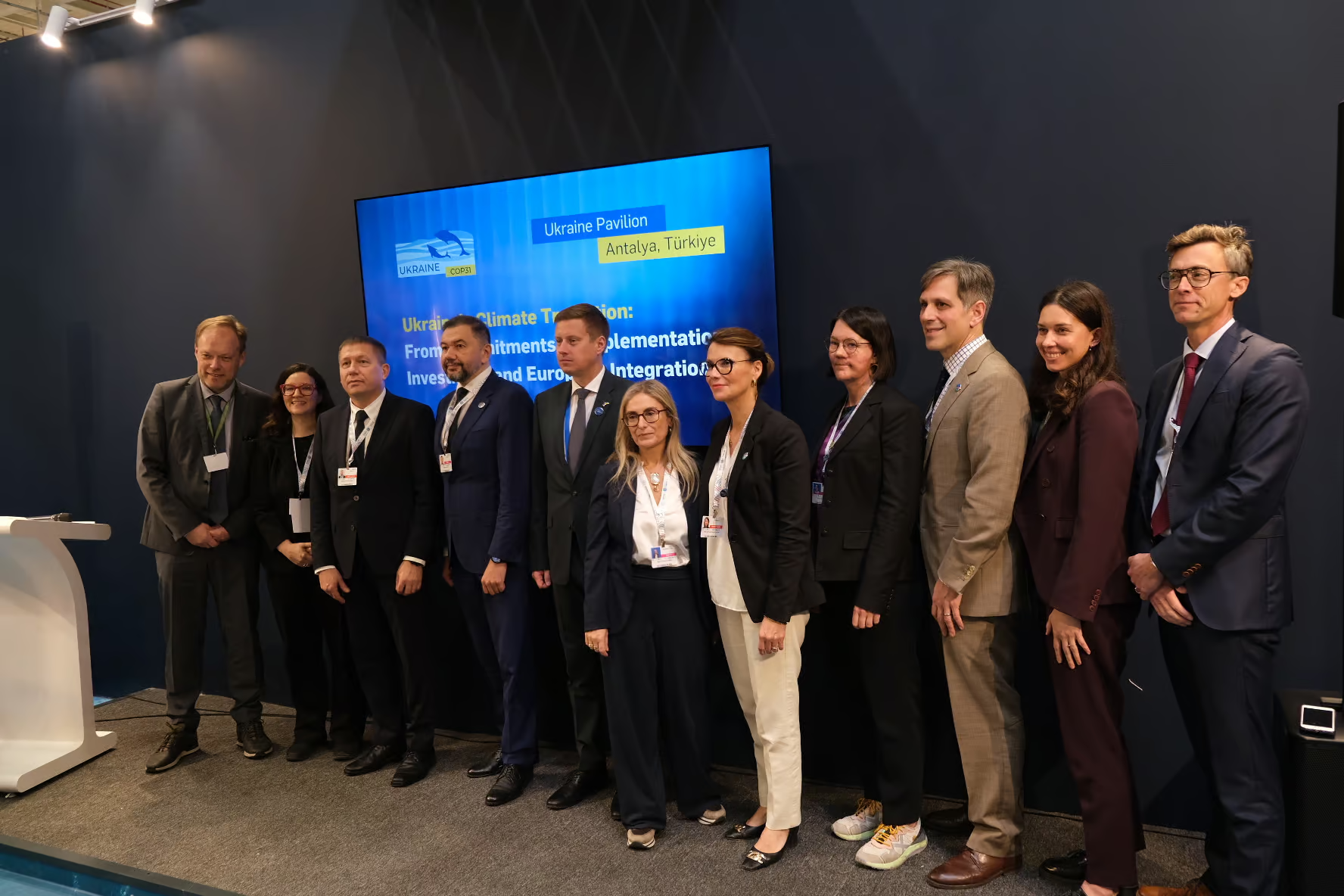
On 18 November 2026, the Ukrainian Pavilion at COP31 in Antalya hosted the flagship high-level event “Ukraine’s Climate Transition: From Commitments to Implementation, Investment and European Integration”, bringing together senior Ukrainian officials, European Union leaders, partner ministers, and international financial institutions to advance practical climate implementation, investment mobilization, and EU accession and Carbon Border Adjustment Mechanism (CBAM) readiness.
Presenting Ukraine’s climate roadmap, Oleksandr Krasnolutskyi, Deputy Minister of Economy and Environment of Ukraine, stressed that climate policy is an active driver of recovery rather than a deferred obligation: “For Ukraine, climate policy is not a commitment ‘for later.’ It is an instrument for recovery, investment, and European integration, and we are implementing it right now.” He noted that while Russia’s full-scale invasion has generated over 311 million tonnes of additional CO₂-equivalent emissions over four and a half years, Ukraine has upheld its targets under the 2024 Law on the Basic Principles of State Climate Policy – including climate neutrality by 2050, a net emissions cut of over 65% by 2035 compared to 1990 levels under its updated Second Nationally Determined Contribution (NDC), at least 27% renewables in final energy consumption, and a 30% methane reduction by 2030.
Krasnolutskyi highlighted that 2026 moved Ukraine from strategy to implementation through establishing the Scientific and Expert Council on Climate Change, submitting its national greenhouse gas inventory to the UNFCCC, drafting legislation for a national Emissions Trading System (ETS) launching in 2028, adopting the Long-Term Low-Emission Development Strategy to 2050 and updated National Energy and Climate Plan (NECP) with a public monitoring dashboard, and initiating an Article 6 pilot alongside the framework for a National Carbon Registry. For 2027, Ukraine is prioritizing the ETS law and expanded MRV coverage, initial Article 6 projects with Japan, Switzerland, and Sweden, carbon pricing reform and CBAM preparation, and the Adaptation Strategy to 2036, backed by a new cooperation memorandum with NEFCO signed at COP31. “Investing in Ukraine’s recovery is investing in Europe’s climate future,” he added.
The dialogue also featured Oleh Bondarenko, Chair of the Verkhovna Rada Committee on Environmental Policy and Nature Management, alongside European Commissioner for Enlargement Marta Kos, DG CLIMA Director-General Kurt Vandenberghe, DG TAXUD Director-General Gerassimos Thomas, Germany’s Federal Environment Minister Carsten Schneider, Estonia’s Energy and Environment Minister Erkki Keldo, Poland’s Climate and Environment Minister Paulina Hennig-Kloska, Moldova’s Environment Minister Gheorghe Hajder, UK Minister of State Katie White, Japan’s Environment Minister Hiroyoshi Sasagawa, Sweden’s Climate and Environment Minister Romina Pourmokhtari, Switzerland’s DETEC Head Albert Rösti, Finland’s Environment and Climate Minister Sari Susanna Multala, Italy’s Environment and Energy Security Minister Gilberto Pichetto Fratin, Spain’s Ecological Transition Minister Sara Aagesen Muñoz, Lithuania’s Environment Minister Ieva Andriulaitytė, UN Assistant Secretary-General Ivana Živković, World Bank Group Vice President James Heimbach, EIB Regional Hub Head Kristina Mikulova, and senior representatives of the EBRD.
Alongside the main event, Krasnolutskyi held bilateral talks on 18 November ahead of the Ukraine Recovery Conference (URC 2027) in Tallinn. With Dr. Heike Henn, State Secretary at Germany’s BMUKN, he expressed gratitude for €10 million in support for national parks and biodiversity as well as cooperation via PAABS, GIZ, and the Frankfurt Zoological Society, while outlining Ukraine’s draft green taxonomy law, approved Circular Economy Strategy, and over 20,000 documented environmental damage cases registered for accountability through the International Register of Damage. In meetings with UNIDO Managing Director Ciyong Zou, Estonian Minister Erkki Keldo, and the Italian office of UNDP, the sides further agreed to advance green industrialization and waste management reforms – including support for opening a UNIDO office in Ukraine – coordinate URC 2027 environmental priorities and CBAM experience sharing, and accelerate an ambient air quality monitoring project ahead of the Tallinn conference.