
The Ukrainian Pavilion at COP31 in Antalya hosted a full day of expert discussions examining how practical adaptation, resilient municipal infrastructure, and digital innovation can strengthen climate action in Ukraine and across the Black Sea region. Spanning four thematic sessions, the program brought together Ukrainian municipalities, civil society, academics, international partners, and financial institutions to share field-tested solutions developed under wartime conditions.
The day opened with the session “Regional Adaptation Exchange: Networks, Gaps and Future Cooperation Priorities in the Black Sea Region”, held within the framework of the IKI-funded PAABS project (Supporting Ukraine in the Implementation of the Paris Agreement and Adaptation to the Impact of Climate Change in the Black Sea Region). Moderated by Anatoliy Smaliychuk, Associate Professor at Ivan Franko National University of Lviv, alongside Olga Denyshchyk from the Michael Succow Foundation and Neslihan Apartan from Türkiye’s Directorate of Climate Change, the dialogue explored how stakeholders from Bulgaria, Georgia, Moldova, Romania, Türkiye, and Ukraine can better connect existing regional and global cooperation platforms rather than creating duplicate structures, identifying concrete priorities for joint workshops, knowledge products, and bilateral collaboration in response to shared cross-border risks such as droughts, floods, and coastal erosion.
Building directly on local implementation, the second panel – “What it takes to replicate local adaptation: Lessons and partnership opportunities from Ukraine” – highlighted how community-level solutions can be scaled nationwide. Moderated by Olha Polunina (Heinrich Böll Foundation, Kyiv–Ukraine Office) and featuring Olha Liashchuk (NGO Ecoclub) and Diana Popfalushi (Ukrainian Climate Network), the discussion showcased Adapterra UA, a national adaptation competition and knowledge-sharing platform organized by Ecoclub with Czech partner Nadace Partnerství. Having attracted 50 applications in 2025 and 51 in 2026 across 19 regions – nearly three-quarters submitted by women – the initiative documents local projects, provides winners with up to UAH 80,000, adapts the Czech Adapterra municipal simulation game for Ukraine, and demonstrates measurable results on the ground, from peatland rewetting in Zalyvky that halted recurring fires to satellite-guided urban tree planting in Rivne.
In the afternoon, “Water Never Stops: Building Climate-Resilient, Energy-Efficient Water Services” turned attention to safeguarding essential municipal utilities under extreme stress. Moderated by Kylie Johnson (Australian Water Partnership / eWater), the panel brought together Mykolaiv Mayor Oleksandr Senkevych, Natalia Kholodova (NGO Ecoclub), Oleksandr Kravchenko (Ukrvodokanalekologia), Till Reinholz (IKEM, Germany), and Marco Beroš (European Investment Bank). Drawing on Ukraine’s wartime experience and international practice, speakers examined how infrastructure modernization, distributed renewable energy, and targeted financial instruments can maintain uninterrupted water supply and wastewater services while cutting emissions and energy costs.
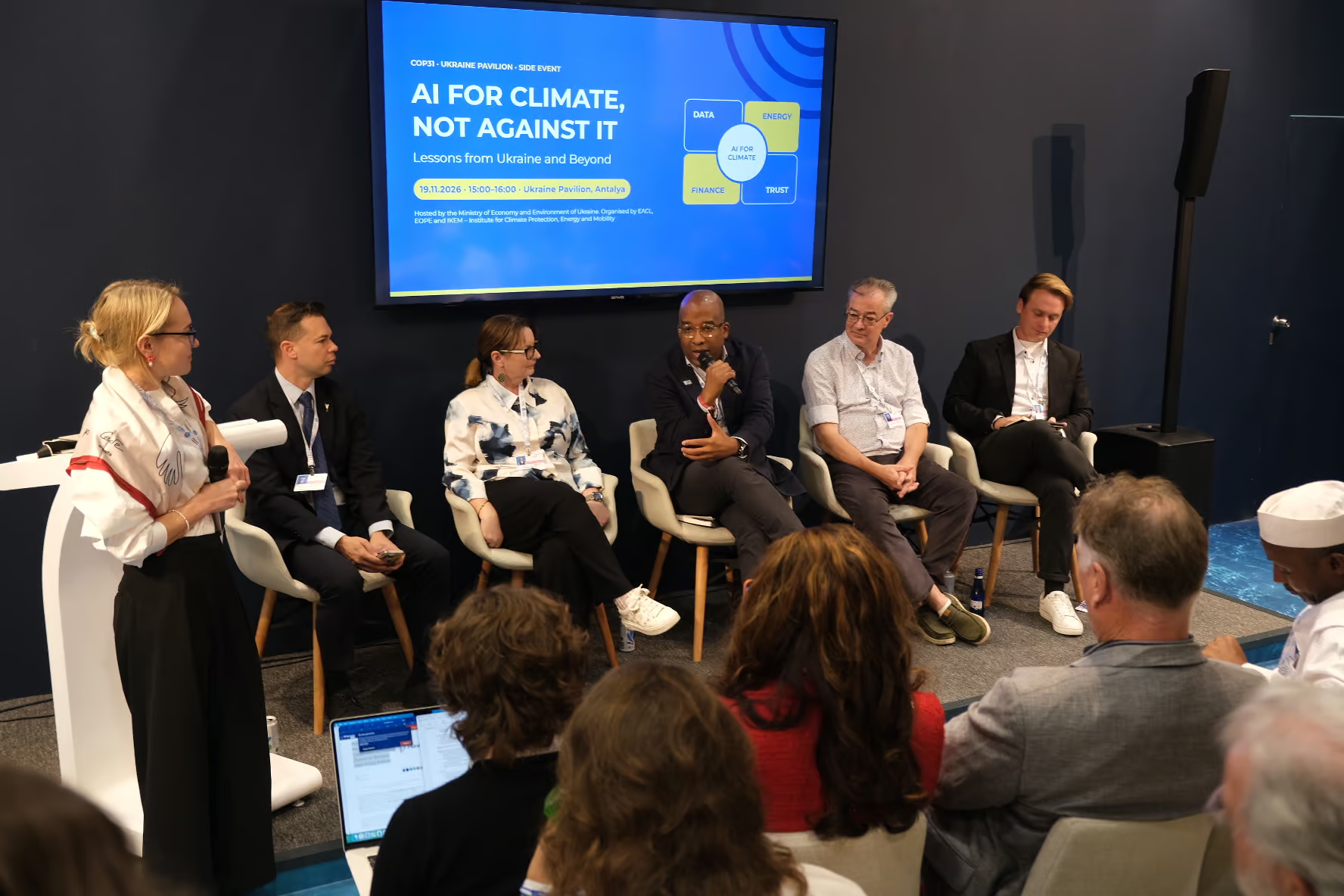
The program concluded with “AI for Climate, Not Against It: Lessons from Ukraine and Beyond”, moderated by Dr. Ievgeniia Kopytsia (Yaroslav Mudryi National Law University and IKEM) with contributions from Anjali Goswami (UK Defra), Priya Donti (MIT / Climate Change AI), Tennant Reed (Australian Industry Group), Prof. Francesco Sindico (University of Strathclyde), and Alex Cornell du Houx (Elected Officials to Protect America). Building on Ukraine’s experience with digital public services such as Diia, DREAM, and EcoZagroza, speakers explored how artificial intelligence can help reconstruct environmental data in war-damaged landscapes and accelerate clean grid electrification, while establishing legal safeguards and managing the growing power and water footprint of AI data centers.