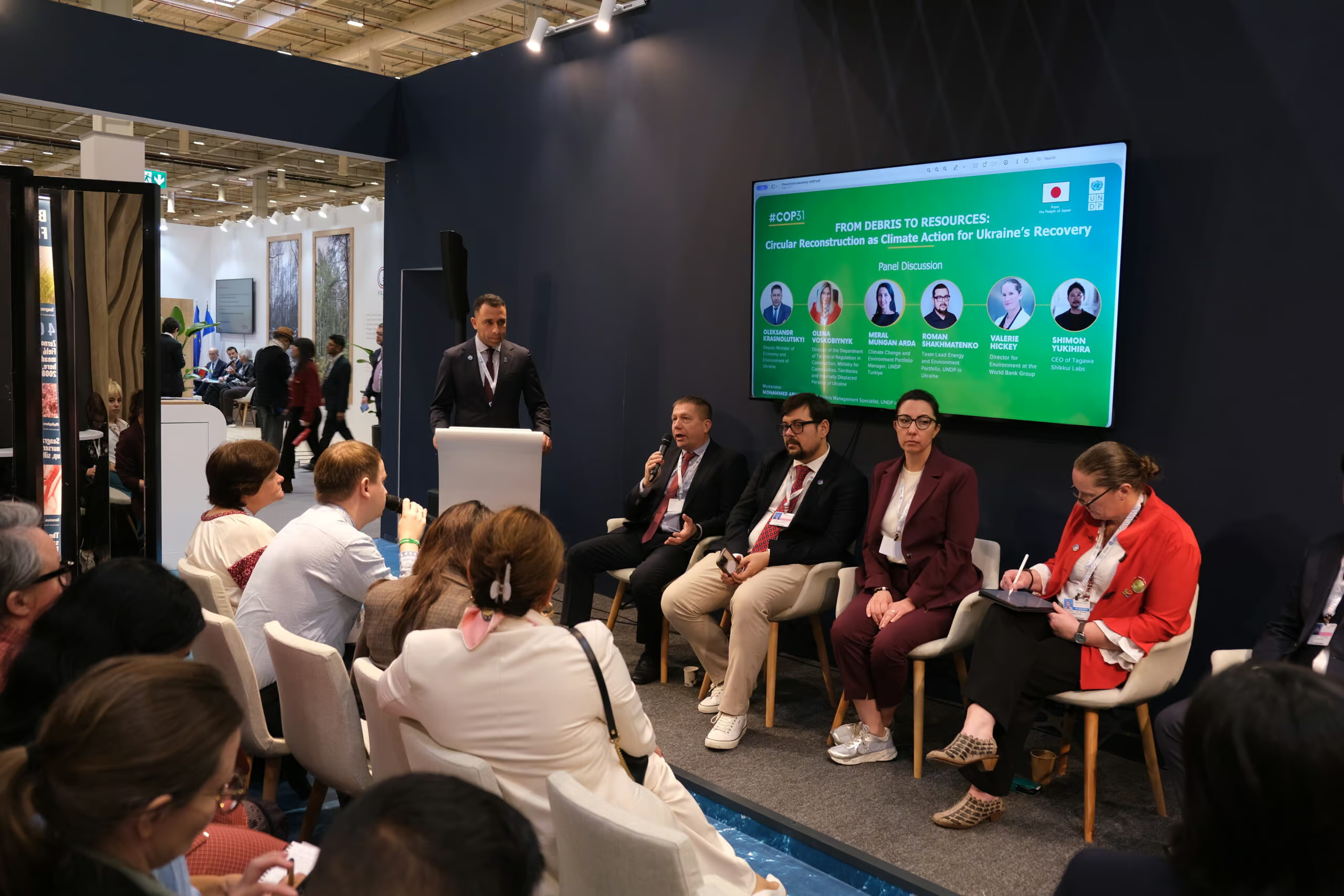
On November 11, the Ukraine Pavilion at COP31 held a full day of discussions on nature conservation, climate adaptation, circular reconstruction, women’s leadership in energy and zero waste. All of them came back to one question: how Ukraine can rebuild in a way that leaves it more resilient than before the war.
 The day opened with a session on cooperation with the International Union for Conservation of Nature (IUCN). Oliver Avramoski, IUCN Regional Director for Eastern Europe, North and Central Asia, said that nature-based solutions tackle “societal and economic challenges while benefiting both people and nature.”
 The discussion “From Debris to Resources” looked at how millions of tonnes of war debris can become material for rebuilding. Roman Shakhmatenko, Team Lead of the Energy and Environment Portfolio at UNDP Ukraine, recalled that there was initially no state protocol for war-related asbestos contamination, so UNDP developed one and the government adopted it. “Just two weeks ago, we opened the first laboratory in Ukraine capable of providing detailed asbestos analysis,” he said.
 At the high-level panel “Ukraine’s Climate Adaptation Strategy until 2036,” the draft strategy was presented to international partners. It links adaptation with recovery planning and EU integration. Deputy Minister of Economy and Environment Oleksandr Krasnolutskyi said that support from partners and donors is essential for Ukraine to implement its strategies and advance its European integration, one of the country’s most important foreign policy priorities today. Mathilde Mesnard, Deputy Director of the Environment Directorate at the OECD, added: “Reconstruction is not only about restoring what has been lost. It is about ensuring that the infrastructure, services, and institutions being built today can withstand the challenges of tomorrow.”
 The afternoon moved from strategy to practice. Ukrainian NGOs shared examples of community-led adaptation projects. Businesses discussed who should pay for recycling and end-of-life management. The “Peatland Twinning” panel showed how the partnership between Ukraine’s Chernihiv region and Germany’s Mecklenburg-Vorpommern is helping to restore wetlands for nature and climate. At “Powering an Inclusive Recovery,” speakers discussed how solar power and storage can open new jobs and leadership roles for women in energy.
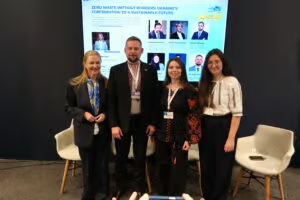 The day of discussions closed with “Zero Waste Without Borders,” where legislators, government officials and partners looked at how EU integration is shaping Ukraine’s waste policy and which solutions already work in wartime.
Further details regarding the schedule of events at the Ukraine Pavilion can be found in the dedicated section of the Ukraine at COP31 website.