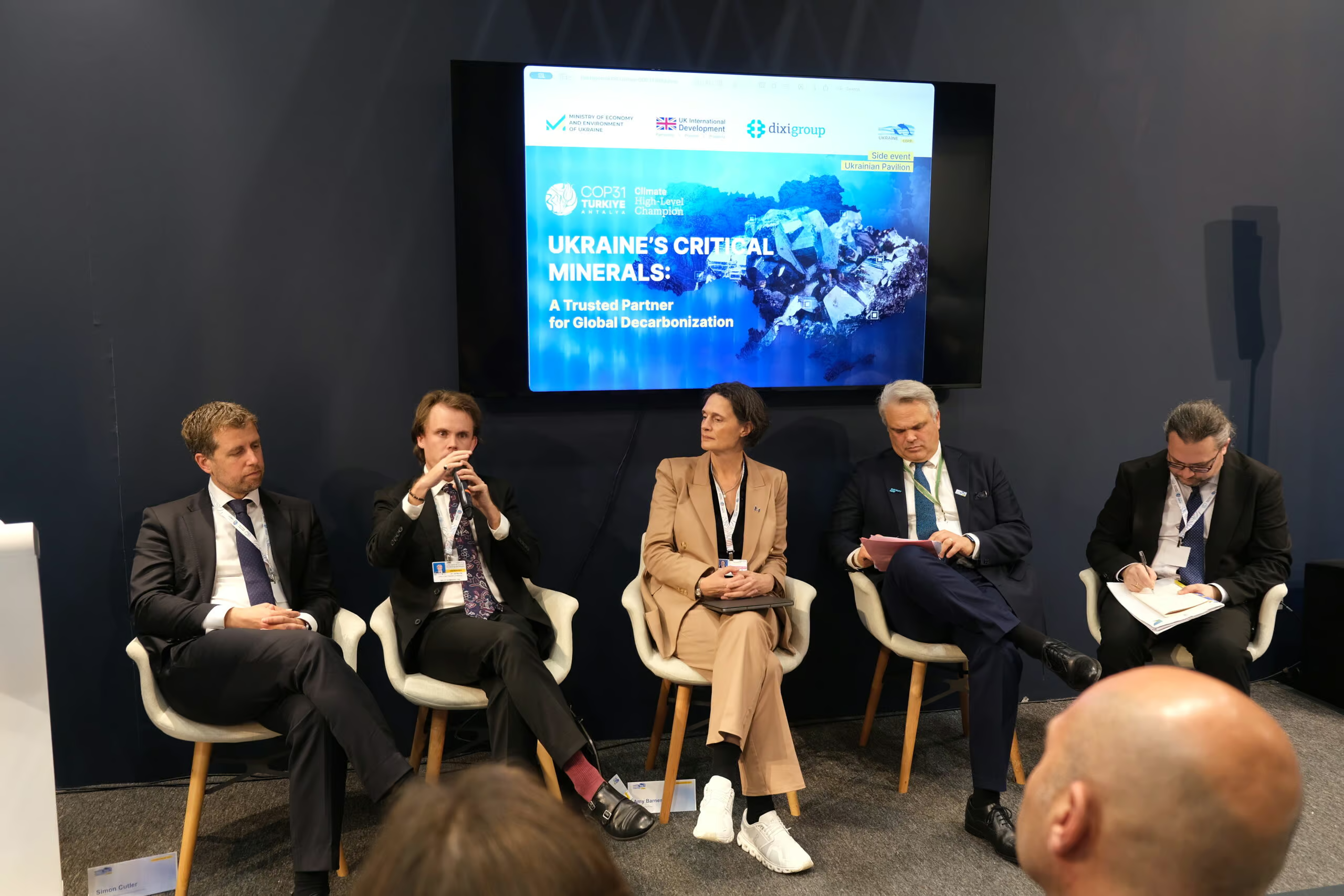
As the global clean-energy transition accelerates, securing reliable supplies of critical raw materials has become a top priority. On 12 November 2026, policymakers, investors, and industry leaders gathered at the Ukrainian Pavilion during COP31 in Antalya for the side event “Ukraine’s Critical Minerals: A Trusted Partner for Global Decarbonization,” organized by DiXi Group in partnership with the Ministry of Economy and Environment of Ukraine. The event was funded by UK International Development under the project “Implementation of Ukraine’s National Energy and Climate Plan and establishment of the Green Transition Office”.
Presenting Ukraine’s Critical Minerals Strategy adopted in June 2026, Yuliia Radchenko, Head of the Subsoil Use Department at the Ministry of Economy and Environment, emphasized that Kyiv aims to build higher value-added industries rather than merely export raw ore. With a 50-year horizon, the Strategy seeks to make Ukraine Europe’s leading critical raw materials hub by 2056 – prioritizing brownfield assets and targeting to offer up to 50% of legacy mining waste for recycling by 2031. Ukraine holds deposits of 26 of the 34 raw materials classified as critical by the EU, including a graphite deposit with EU Strategic Project status, noted Kseniya Orynchak, Executive Director of the National Association of Extractive Industries of Ukraine. Despite severe wartime pressures – including grid attacks, Black Sea port threats endangering USD 800 million in annual iron ore exports, and the occupation of two major lithium deposits – companies continue to operate and invest in their own energy resilience.
To attract private capital, Ukraine must speed up timelines without lowering standards. Simon Cutler, Head of Public Policy and International Affairs at Fortescue, noted that the global average of 15 to 16 years from discovery to production is far too long, urging Kyiv to streamline permitting. John Lindberg, Senior Manager for Policy and Government Affairs Principal at ICMM, added that aligning with European industrial norms – “a common operating language” – makes it easier to simplify regulation without compromising safeguards.
Risk coverage remains another major bottleneck. Amy Barnes, Global Head of Energy & Power at Marsh, pointed out that while commercial insurers cover conventional risks today, war-risk guarantees must come from governments to unlock blended finance. “There’s no silver bullet,” she noted. Meanwhile, Roman Nitsovych, Research Director at DiXi Group, stressed that upgrading legislation to the latest EITI Standard and EU rules is vital to build investor trust and counter hostile information operations.
Closing the gap between policy and financing will ultimately depend on deeper European integration. Anthony Agotha, EU Special Envoy for Climate and Environment (EEAS), noted that Brussels is mobilizing finance through the Ukraine Investment Framework, including linking Ukraine’s Strategic Project in graphite with financiers and tech providers. Calling EU enlargement policy “our crown jewel,” he stressed that Ukraine must become fully integrated into European value chains rather than remain a third-party supplier